
I’ve been working as a fractional CMO and enterprise SEO consultant for over 2 years now.
So yes, I’m going to spend the next 1900+ words convincing you how colossally stupid it would be for you to hire me. Or any other fractional CMO.
What You Actually Get When Hiring a Fractional CMO
You may think you’re getting a third of someone’s time at a third of the price. You are not.
It’s more like 15% of the time at 50% of the price.
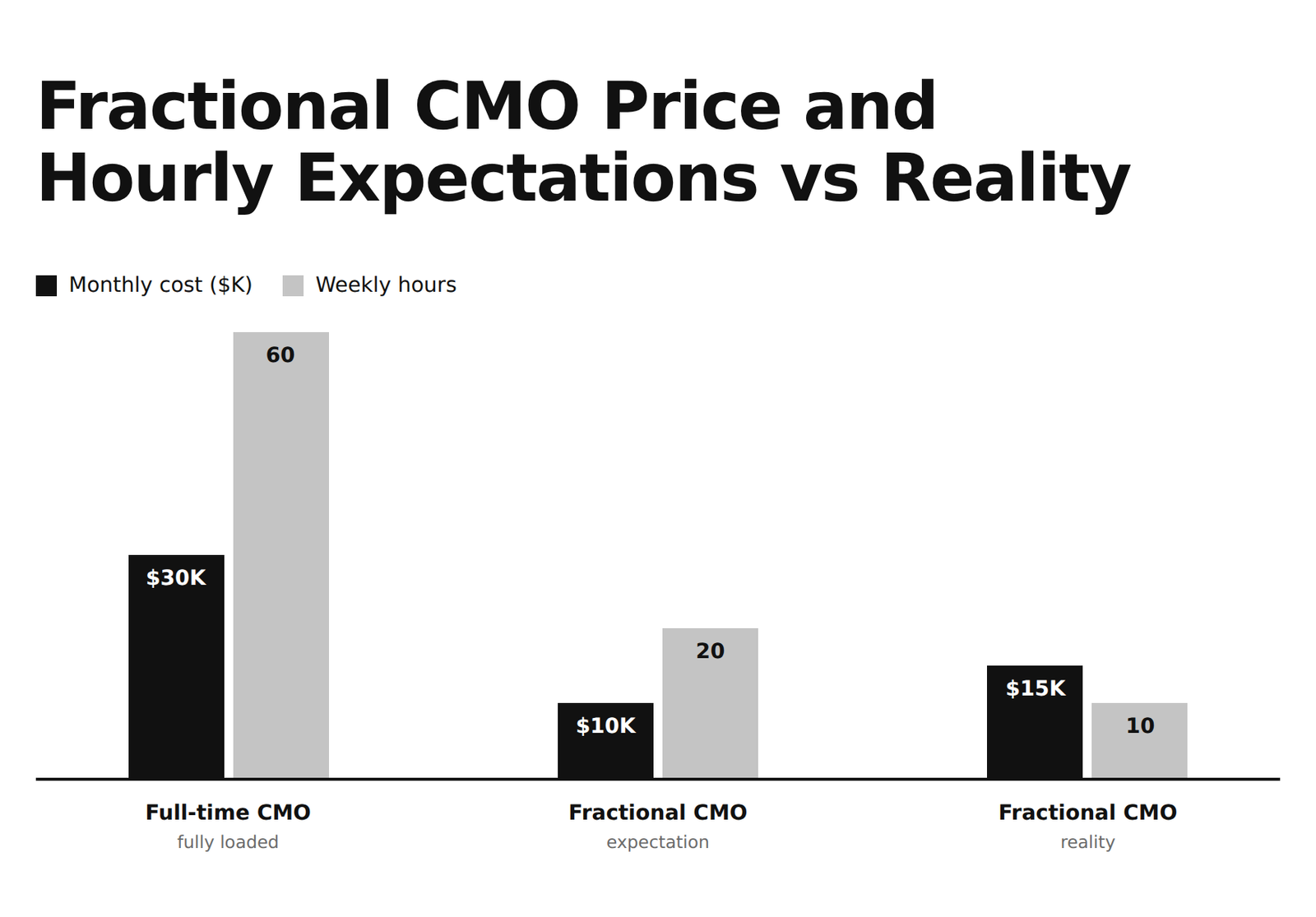
First, the full-time CMO baseline (fully-loaded):
- Monthly Cost = $30K
- Weekly Hours = 60
I’m assuming a $300K base, plus the standard 20% bump to cover taxes and benefits. So $360,000 total which gives us $30K/month.
Yes, some CMOs make less than that. To which I say:
- They’e vastly underpaid
- They’re not in a CMO role, they’re in a VP role
- They’re in a small startup that should not have filled the CMO slot yet and comp reflects that
As for the 60 hours, I’m assuming a standard, intense leadership role. Plus all the spare cycles they spend obsessing about how to improve your business (in the shower, walking the dog, etc). You get that obsession level of commitment.
As the CEO, you might say to yourself: “gosh, $30K/month is a lot. And I don’t need 60 hours per week. I bet I can get someone for $10K/month for 20 hours per week. That seems reasonable.”
Reasonable? Yes. Likely? No.
Fractional CMO Expectations
- Monthly Cost = $10K
- Weekly Hours = 20
Fractional CMO Reality
- Monthly Cost = $15K
- Weekly Hours = 10
A good fractional is likely going to settle into a rhythm of 2-3 clients. And if they’re good, they’ve got a waitlist.
But 3 clients doesn’t mean you get 1/3 of their time. Wise fractionals will protect some of their time to market themselves. At least 25%.
Also, they’re not working 60 hours a week anymore. Fuck that, they have hobbies, kids, therapy, ayahuasca retreats. They’re not grinding like they did earlier in their careers. If they were, they probably wouldn’t be doing the fractional thing in the first place. There are bigger games to be played elsewhere for the folks still punching it. For fractionals, these are 40 hour weeks, max. Probably less if we’re being really honest.
At best, all this gives about 1.25 days/week/client on a standard 40 hour work week.
Or 10 hours/week for a nice, round number.
Instead of paying $300K (fully loaded at $360,000 after taxes and benefits) for 60 hours/week, you’re paying that fractional at least $15K/month. Better than $30K/month but not when they’re working 1/6 the amount of time they would as a full-time employee.
Also, $15K/month is a mid-tier rate. The good fractionals charge in the range of $20-30K/month.
A good full-time CMO provides plenty of outsized return on the comp that you’re investing in them. A good fractional CMO? More of an even trade if they’re good. And if they’re not good, the ROI goes upside down quick.
Marketing Is a Mission-Critical Function, You Need Someone Obsessing About it 24/7
I forget where I heard this, some dusty business tome, but every business boils down to just 2 functions:
- Distribution
- Product/service delivery
You can outsource pieces of each but you cannot outsource the responsibility of either function entirely. If you care about the health of your business that is.
Guess what you’re doing with a fractional CMO? You’re outsourcing a huge chunk of distribution to someone that’s only going to think about your business for 10 hours a week. One of the two KEY functions of your ENTIRE business.
Insanity.
No holds barred honesty time: any good CEO realizes this in their bones. They know how important distribution is. They realize CMOs are expensive. They also realize they pay for themselves if they’re good. So the talented CEOs find a way to get a full-time CMO recruited. And they find a way to make the budget work.
“Lars, did you just call me a bad CEO if I hire you?”
Yes, yes I did.
The Unspoken Risk: Blowing Everything Up When You Hire a Full-time CMO
If you go the fractional CMO route, they will get some stuff built. Some of it will be good, some of it needs more iteration (like everything).
But let’s be honest: function heads can be an egotistical bunch. It takes crazy restraint to look at a program you didn’t build, and accurately assess what’s good or bad.
Most of us don’t do that.
We just rip the whole thing up because it’s not “ours.”
Your next CMO, whoever they are, will likely do that to the majority of what the fractional CMO built.
It’s the same reason why every CMO wants to redesign the website. Do you NEED a new website? Fuck no. But by god the old one didn’t get the CMO stamp so it’s gotta go.
That will likely happen to everything your fractional build.
Doesn’t happen every time, I would say it happens the majority of the time.
ESPECIALLY if marketing is a bit choppy in the beginning of the tenure for your new CMO. A tale as old as time on leadership teams: blame everything on whatever sucker held your seat last. So the more that marketing struggles, the more work from the fractional CMO that gets ripped up.
This is the unspoken risk of hiring any fractional CMO. You think you’re speeding up or “getting started on marketing early” but in reality, it all gets redone anyway.
How Do Fractional CMOs Make This Deal Work?
So the ROI isn’t necessarily great for the CEO. How in the fuck do fractionals keep getting companies to agree to stuff like this?
Leverage.
The cardinal rule of all negotiations: the person that cares the least wins.
Really good CMOs have racked up a bunch of career wins already. Probably made some money along the way too. They have runway. They have options. They don’t NEED your paycheck.
The good ones also have plenty of lead flow for themselves. They have a network or a personal brand. They get full-time offers somewhat regularly.
And they’re in a position to say no.
Which means they’re also in a position to capture more of their value for themselves instead of letting a CEO capture it all.
The Better Path to Getting Your Marketing Department Started
Instead of paying out the nose for a CMO, here’s a fairly common route to getting your marketing department off the ground:
- Hire your first jack of all trades marketer. Give them 1-2 channels to get lead gen going.
- If they get 1-2 channels humming, give them a few direct reports and have them keep building. Expand into more channels.
- If they can keep up with the pace, keep promoting them until they hit a ceiling. There is a delicate balance here. If you go too fast, they flame out. If you go too slow, the good ones bounce to bigger and better things.
With a bit of luck, you’ll get a solid Director that’ll hold you over until your business is large enough to need a real VP or CMO. And if you’re REALLY lucky, that original marketer will grow into a true leadership role.
“Lars, doesn’t this mean I have to closely oversee marketing for a long time?”
YES IT DOES.
It’s one of the critical functions of your business. Get used to it.
The (Rare) Situation Where a Fractional CMO Still Makes Sense
First, let’s look at the classic fractional role: CFOs.
Fractional CFOs have been around for a really long time. We had one at the first startup I worked for. Very common in any VC-backed startups for a few reasons:
- If you’re raising rounds, the complexity of your funding, accounting, and cap table drastically outstrips a business at a comparable size.
- So you need a level of expertise that’s atypical at that level. You need a CFO way earlier than normal. A typical controller or Director of Finance is not going to cut it.
- You are committing to a path with lots of expectations and standards built around it: raising successive rounds until you get a (hopefully) attractive exit. It really helps to have someone that knows what those expectations already are.
Does it matter if you get a perfect ROI on that fractional CFO? No. You need speed and expertise more than you need cash flow. Do most businesses need this? Absolutely not. It’s for a particular situation where speed matters more than cash. Because speed equals boatloads of cash later.
In situations like this, fractional CFOs made perfect sense. That’s why they’re fairly common in tech.
Now let’s apply that framework to fractional CMOs.
If speed and expertise matters more than a perfect ROI, a fractional CMO can make a lot of sense.
That’s also where I feel like I’ve had the biggest impact for my own clients. When it’s go go go mode and a CEO needs an entire marketing department spun up within 90 days, fuck yeah, let’s do this. Everyone wins.
If you have clear product/market fit, plenty of budget, and need to spin up a marketing department from scratch, a good fractional CMO can get you:
- Paid channels spun up and driving pipeline within 90 days
- Mid-length channels (like affiliates) driving pipeline within 6 months
- Foundation laid for organic channels to start compounding over 12+ months.
You solve pipeline problems this year and plant the seeds you need to keep growing pipeline next year. For some companies, the speed and reliability of hitting pipeline growth matters way more than arguing about how many hours a fractional CMO happens to be working.
But it aint cheap.
This also assumes the fractional CMO has a network of trusted folks to get all that spun up quickly. If they have to do much in the way of trial and error (like a stretch CMO), there just isn’t enough hours to build up momentum fast enough. A stretch CMO can compensate with blunt force via hours, a fractional cannot.
Requirements Before Hiring a Fractional CMO
None of this makes sense when a business is puttering along, thinks they might have a marketing problem, doesn’t know how to acquire more customers, and hopes a fractional CMO is going to fix things. They likely won’t.
If you’re not growing a smidge, you likely have a product problem. Go solve that. If you think you have a positioning problem, go talk to a positioning consultant and do a one-off project with them. Most CMOs aren’t that great at positioning anyway. If your budget is constrained and it’s already a stretch just to pay the fractional CMO, it’ll never work.
Make sure you meet these requirements before considering going the fractional CMO route:
- Product/market fit is strong. If you have any concerns here, go solve that first. And you should fix this before hiring a full-time CMO too.
- Your cash flow is insane or you raised a ton of money.
- Spending a year developing in-house marketing talent isn’t an option. Your market is moving too fast, competitors are too aggressive, that sort of thing. Speed should be your number one priority.
- I’d have a marketing budget of at least $50K/month on top of whatever you plan on paying a fractional CMO. Plan on an additional $15-30K/month for their retainer. $100K/month and above is where you have real options.
So if you have a war chest, P/M fit is nuts, and you want to brute force your pipeline while worrying about perfect ROI later, then yeah, start talking to fractional CMOs. A good one will get you there.
For everyone else, go do it the boring long-term way and develop your marketing talent in-house. At least until you can afford a full-time CMO.
The Last Exception: a Marketing Leader You Really Trust
There’s one more situation where I could understand a CEO hiring a fractional CMO.
Same reason for why I pay my CPA an exorbitant amount of money.
I have worked with a ton of CPAs. And boy oh boy have there been some fuckups. Almost got forced into collections with the IRS because of an attempted double payment triggered by one CPA. Not a missed payment, an accidental double payment. Which I had the blessed fortune to learn also triggers fees (and interest) from the IRS. Delightful. That was a supposedly top-tier CPA firm too, not a fly-by-night neighborhood CPA.
When it comes to my CPA, I care WAY more about zero fuckups than I care about saving money. My current CPA is totally overkill for the size of my business but I have worked with them on really intense business structures previously. They already handled the insane shit, they can handle my current stuff without breaking a sweat. I trust them.
So yeah, I don’t care about optimizing my CPA budget even though I’m overspending.
I could see a CEO doing something similar with a fractional CMO. Could see myself doing something similar too.
If business was humming, I wanted to downshift as a CEO, and I just needed someone that wasn’t going to fuck things up and I could trust to own marketing without any oversight, then yeah, paying their fees makes sense. Finding super trustworthy folks is not easy. When you do find one, pay them. Just make sure your business goals align with what a fractional CMO will put in over the long term.
Obviously, the overall business needs to be in a super healthy place and you need great margins but in that case, go for it.


